Preservation exhibit highlights Nzilani’s accomplishments
Dumbarton House, NSCDA headquarters

Ariana Makau is drawn to photography, science, math, documentation, and hands-on work - a group of interests that meshed perfectly into a profession in stained glass conservation. Makau studied stained glass fabrication in Paris, earned (as the first woman in the world to do so) a masters degree in stained glass conservation in London, and worked in such institutions as the Victoria and Albert Museum and the Metropolitan Museum of Art, all before founding her company, Nzilani Glass Conservation.
What does it take to start your own preservation-related business/organization?
Ignorance and ambition! Had I known what it would take to run a successful business at
the beginning, I would have been too intimidated. But from the start, I knew Nzilani would provide something unique in the world of preservation based on our mission: “Be Safe. Have Fun. Do Excellent Work.”
What types of challenges have you faced in your work?
I learned that sometimes you can’t convince a potential client that your company is the best choice for the job if they can’t see past the fact that it’s run by a Black woman. The same goes for traditional access to capital. I no longer expend an exorbitant amount of time trying to change someone’s mind when there are other clients and funders who immediately see value in Nzilani’s commitment to safety, fun and excellence in everything we do. It’s important to preserve your integrity and align yourself with allies.
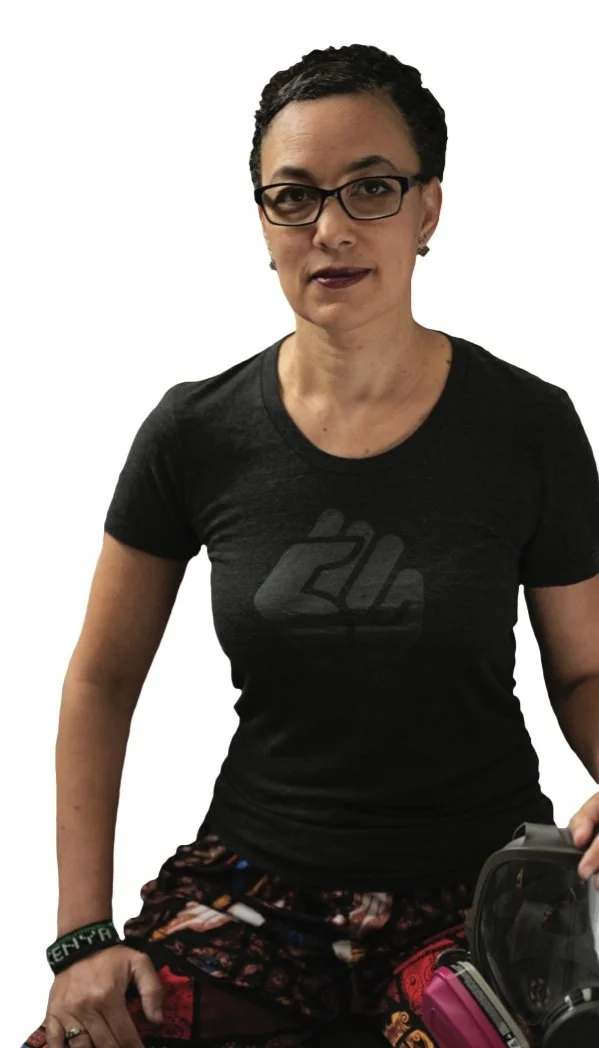
Photo credit: Greg Tuzin
How would you encourage young people to become preservationists?
Be curious, ask questions and know your worth. Just because
someone has been in the profession longer than you doesn’t mean they have all the answers. You may come with a different approach that will advance a technique or propose an entirely new perspective through your life experience. Speak up. Likewise, a lot can be learned from observation before embarking on a task that’s new to you. At Nzilani, attention to detail and the ability to positively learn and grow from your mistakes are keys to success.
Looking forward, how would you like to see the field change?
Having a narrow vision of who is qualified eliminates a wide swath of skilled people who want to contribute to the world of preservation and may be limited only by lack of opportunity. Valuing different ways of learning paired with variable skill sets will expand the possibilities of who can be part of our workforce. Our field includes: art history, research, math, drawing, working with your hands, troubleshooting and building things. You can learn these skills at college, an internship, or on the job. At Nzilani, we say the only thing that can’t be taught is being inquisitive.

Photo credit: Nzilani Glass Conservation
What project are you most proud of?
Recently we conserved a 118-year-old, ten-foot inverted stained glass dome. It involved working with engineers, architectural metalsmiths, fine woodworkers, and the Nzilani team. From the get-go we knew it was going to be challenging because we were working against gravity. The dome was so dirty that you could barely see any of the color underneath, but there were tiny flashes of glass jewels peeking through. The first day I laid eyes on it, I was convinced Nzilani HAD to do the job. We completely rebuilt all twelve panels on custom-built, wooden convex and concave “cradles”. With the help of the metalsmiths, we designed an interlocking, complex curved steel bar grid to engage with the original frame to support the panels in place. The end result is this jewel of a piece in the ceiling with multi-colored and beveled glass. The colors transmitted on the floor through the glass add an ethereal quality to the space. It’s wonderful to bring it back to life for another generation and we were recognized with a California Preservation Foundation Award for our efforts.
What is next for you?
As Nzilani has grown, I’ve made a conscious effort to incorporate an element of community engagement – in health and safety, plus outreach. We strive to make our profession more equitable by making ourselves more accessible to previously underserved people and projects. Continuing to align myself and Nzilani with others to amplify this vision should bring more exciting opportunities our way. For example, this summer I plan to work as the Preservation Expert with HOPE (Hands-On Preservation Experience – an offshoot of the National Trust for Historic Preservation) with an all women crew on a window restoration project in Oregon.
Read the original publication here.