Windows To The Past - Traditional Building
Windows to the Past
How Nzilani Glass Conservation brings stained glass back to life.
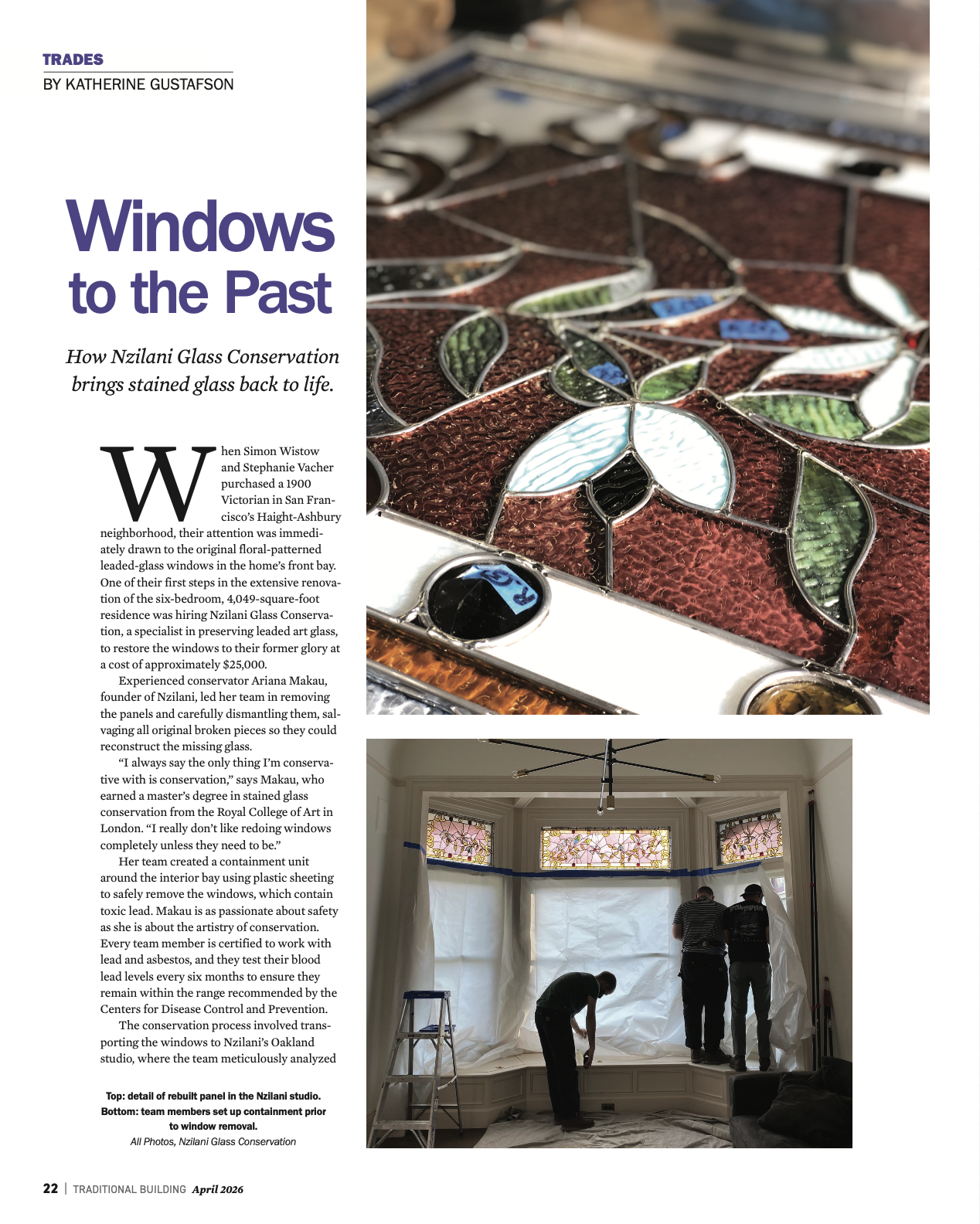
When Simon Wistow and Stephanie Vacher purchased a 1900 Victorian in San Francisco’s Haight-Ashbury neighborhood, their attention was immediately drawn to the original floral-patterned leaded-glass windows in the home’s front bay. One of their first steps in the extensive renovation of the six-bedroom, 4,049-square-foot residence was hiring Nzilani Glass Conservation, a specialist in preserving leaded art glass, to restore the windows to their former glory at a cost of approximately $25,000.
Experienced conservator Ariana Makau, founder of Nzilani, led her team in removing the panels and carefully dismantling them, salvaging all original broken pieces so they could reconstruct the missing glass.
“I always say the only thing I’m conservative with is conservation,” says Makau, who earned a master’s degree in stained glass conservation from the Royal College of Art in London. “I really don’t like redoing windows completely unless they need to be.”
Her team created a containment unit around the interior bay using plastic sheeting to safely remove the windows, which contain toxic lead. Makau is as passionate about safety as she is about the artistry of conservation. Every team member is certified to work with lead and asbestos, and they test their blood lead levels every six months to ensure they remain within the range recommended by the Centers for Disease Control and Prevention.
The conservation process involved transporting the windows to Nzilani’s Oakland studio, where the team meticulously analyzed the three core components of their construction: the glass pieces, the lead strips (known as cames), and the putty that secures the glass within the lead. They documented their research and findings in detail, providing the homeowners with a comprehensive record of both the windows’ history and the restoration process.
“We want our clients to become collaborators in this process of historic preservation,” says Makau. “There’s no win in becoming the Wizard of Oz—‘Pay no attention to what we’re doing in our studio!’ We’re not going behind the curtain and then revealing something that simply looks new.”
Traditional trades like stained-glass conservation benefit from demystifying the work, she adds, much like apprenticeship programs do. “Part of that is pulling those curtains back and letting people see all the different steps it takes to conserve a window.” To further that mission, Makau founded The Fillet Foundation to expand access to conservation careers for underrepresented groups.
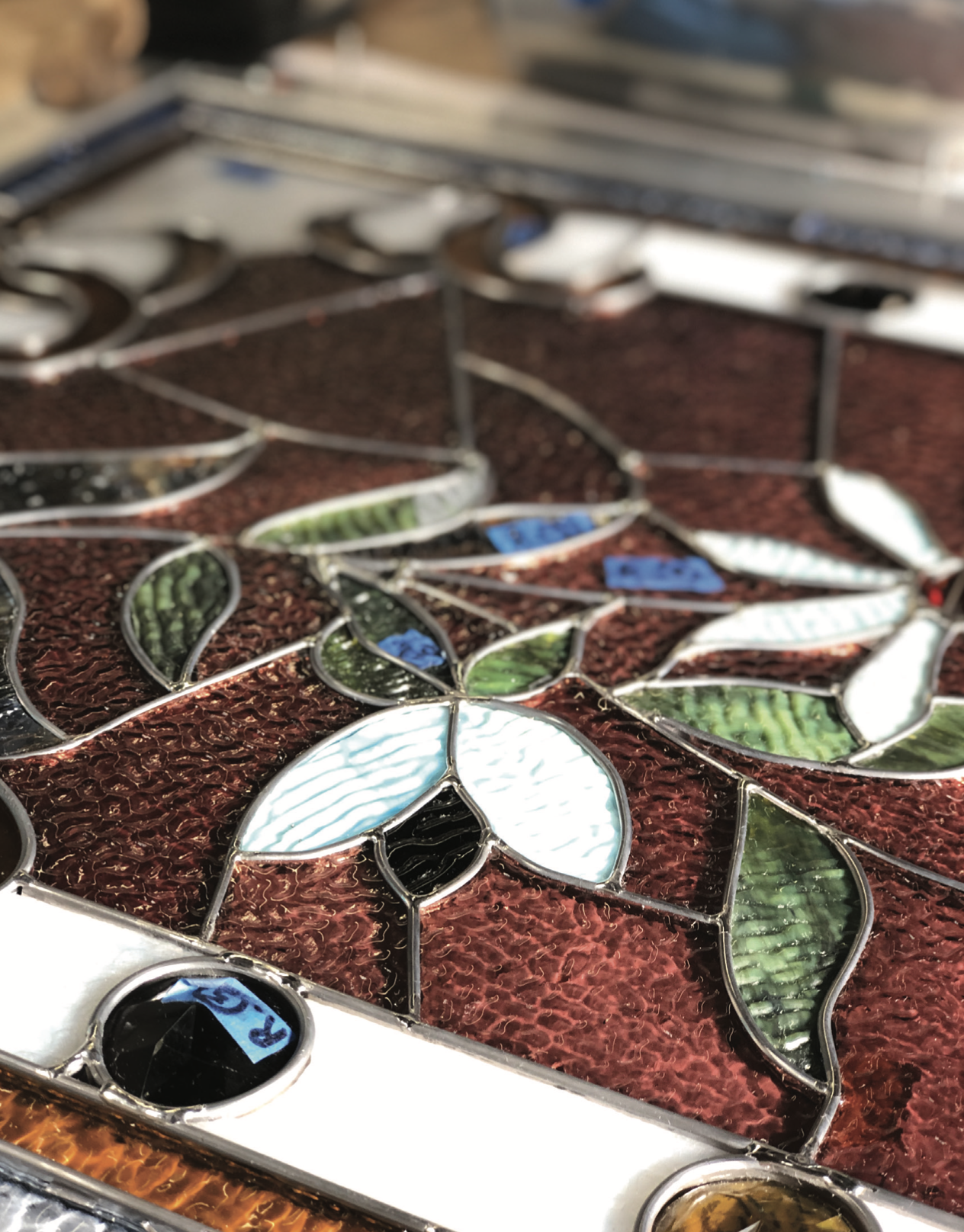
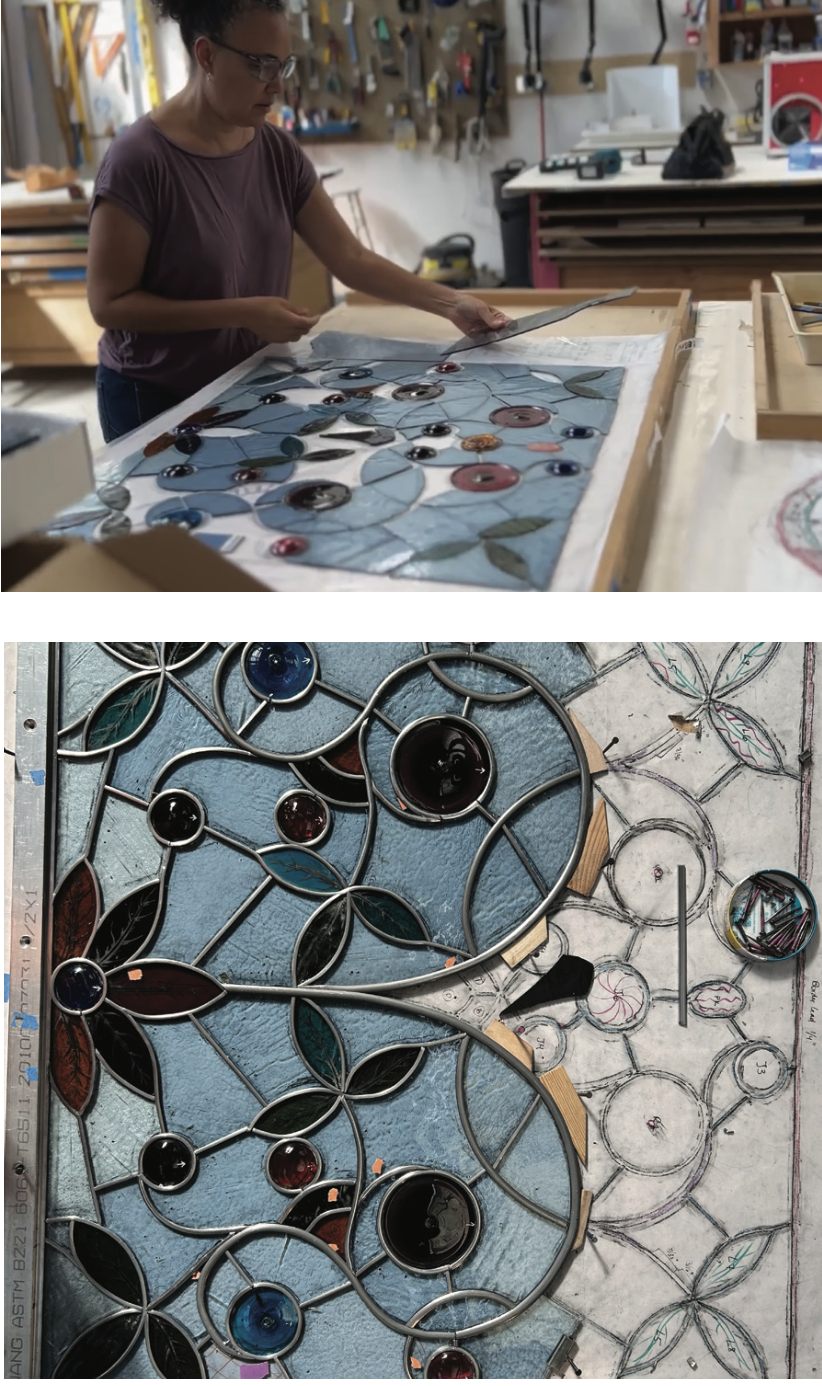
detail of rebuilt panel in the Nzilani studio. - All Photos, Nzilani Glass Conservation
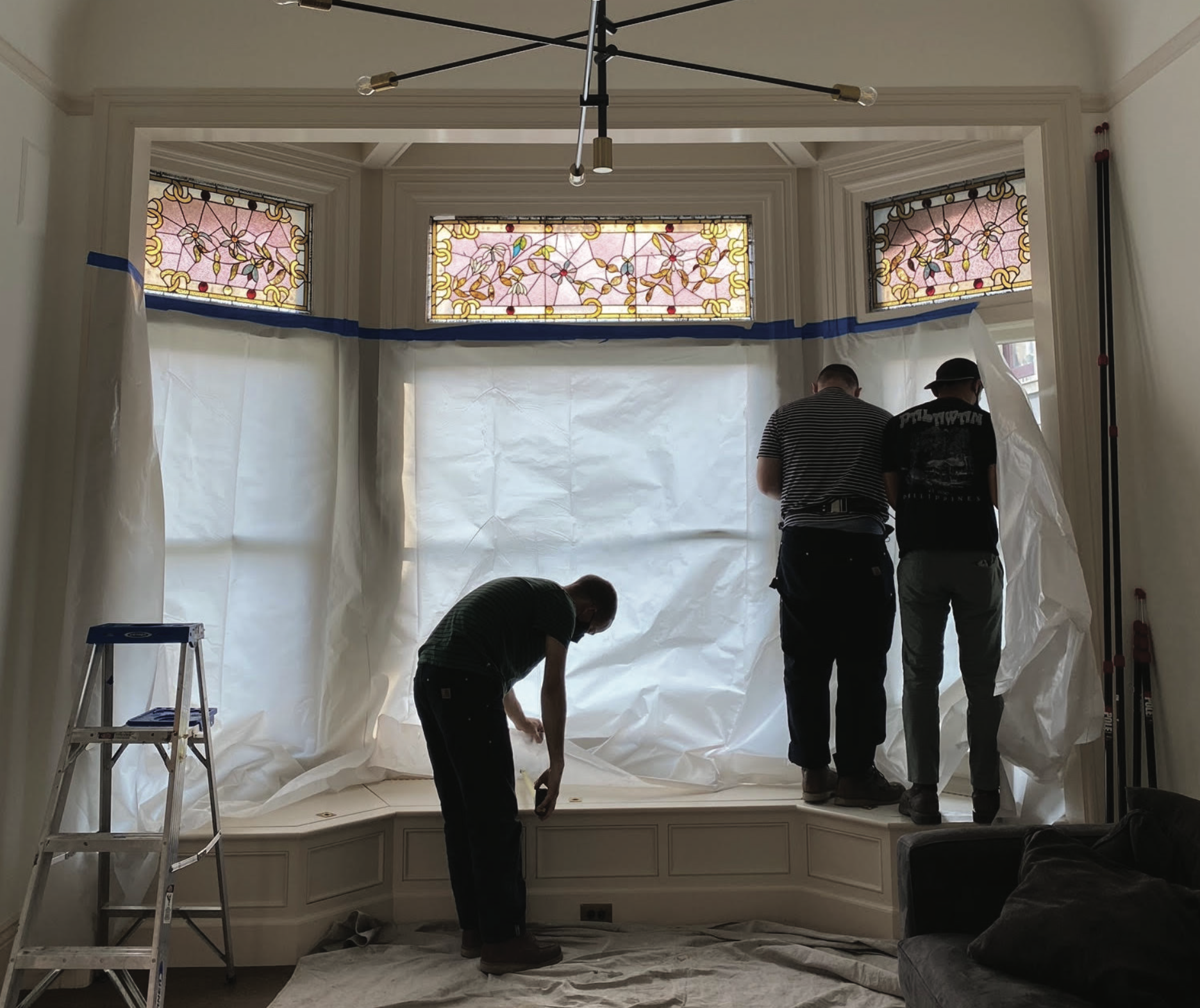
Team members set up containment prior to window removal. - All Photos, Nzilani Glass Conservation
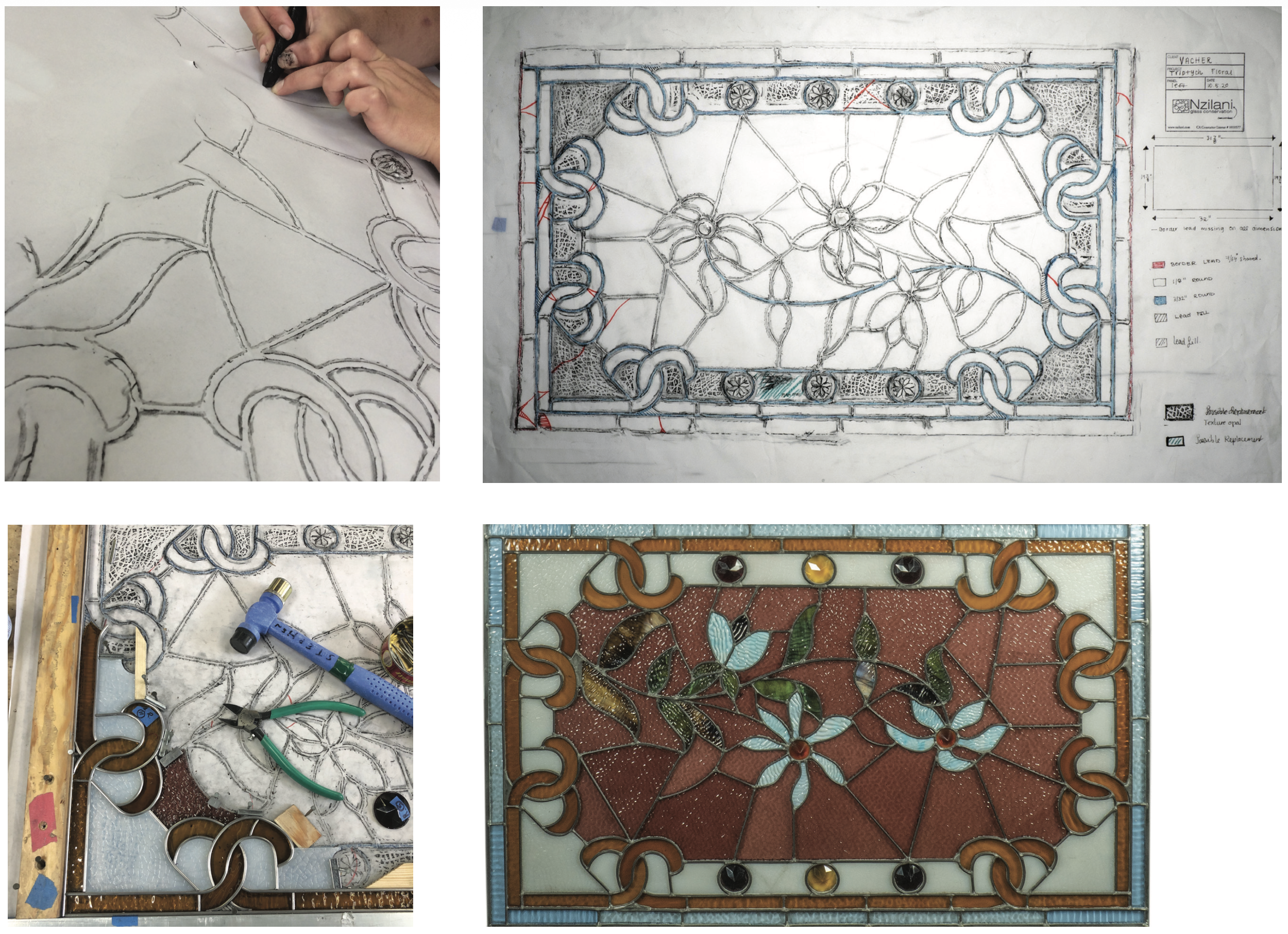
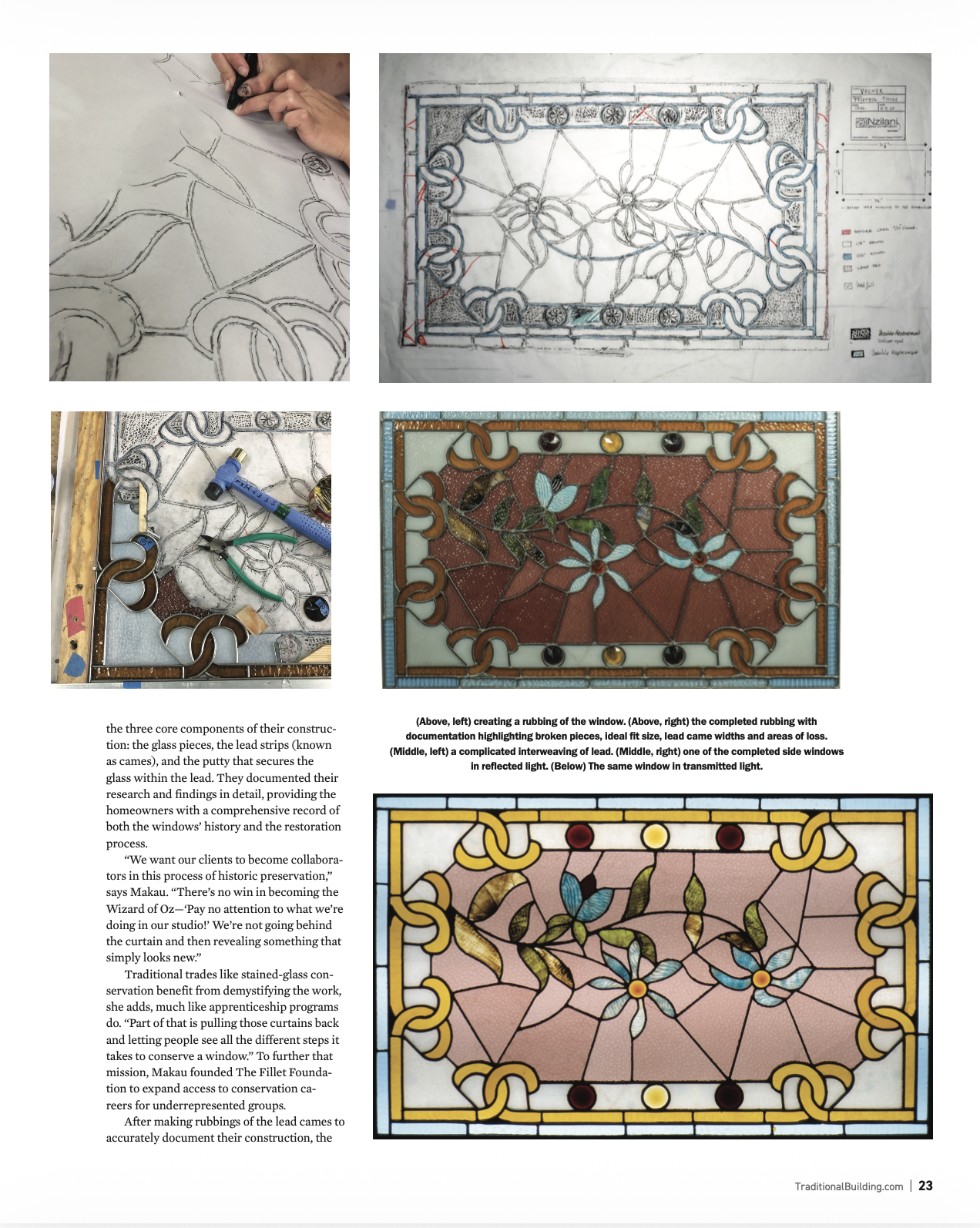
(Above, left) creating a rubbing of the window.
(Above, right) the completed rubbing with documentation highlighting broken pieces, ideal fit size, lead came widths and areas of loss.
(Middle, left) a complicated interweaving of lead.
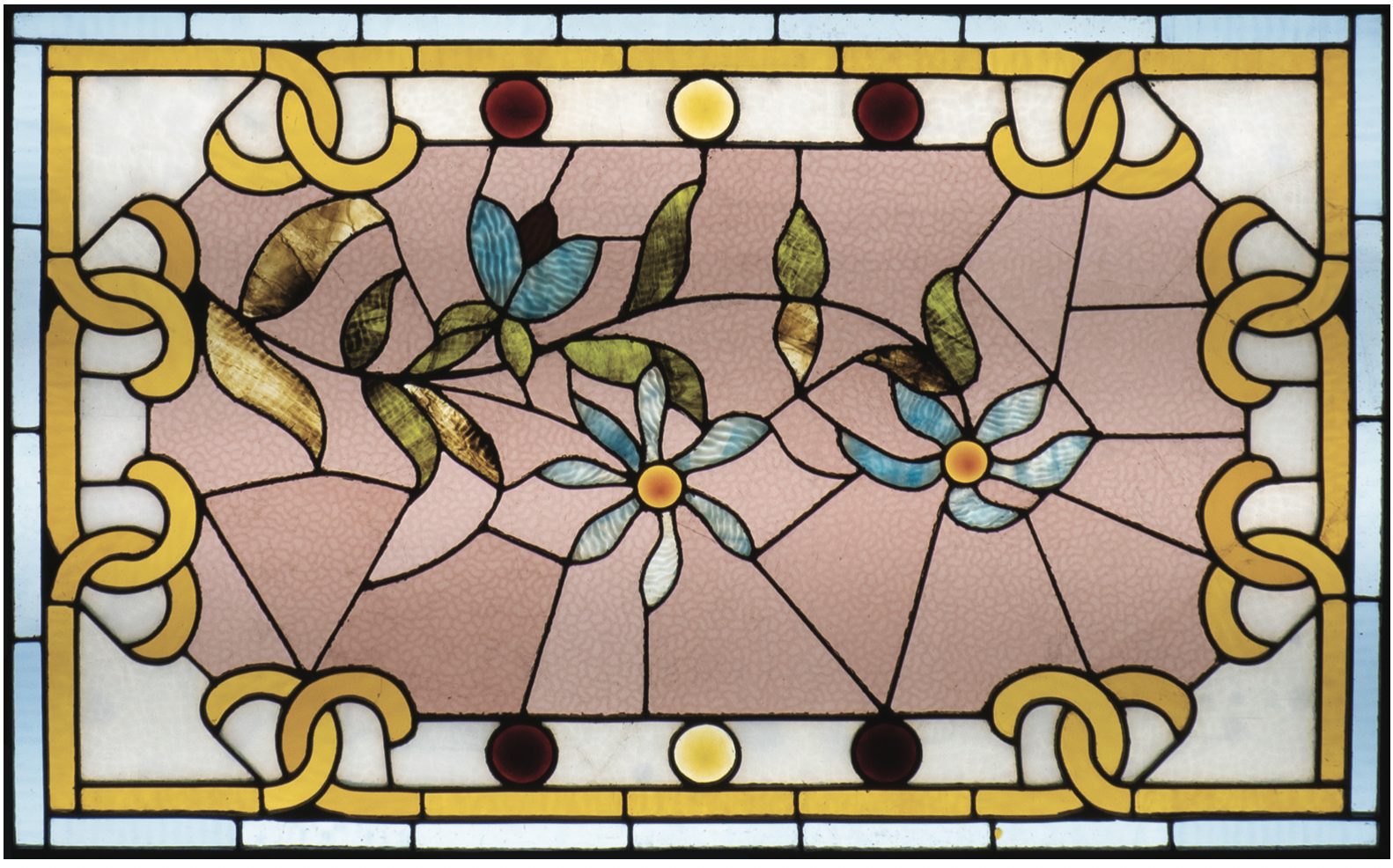
(Middle, right) one of the completed side windows in reflected light.
(Right) The same window in transmitted light.
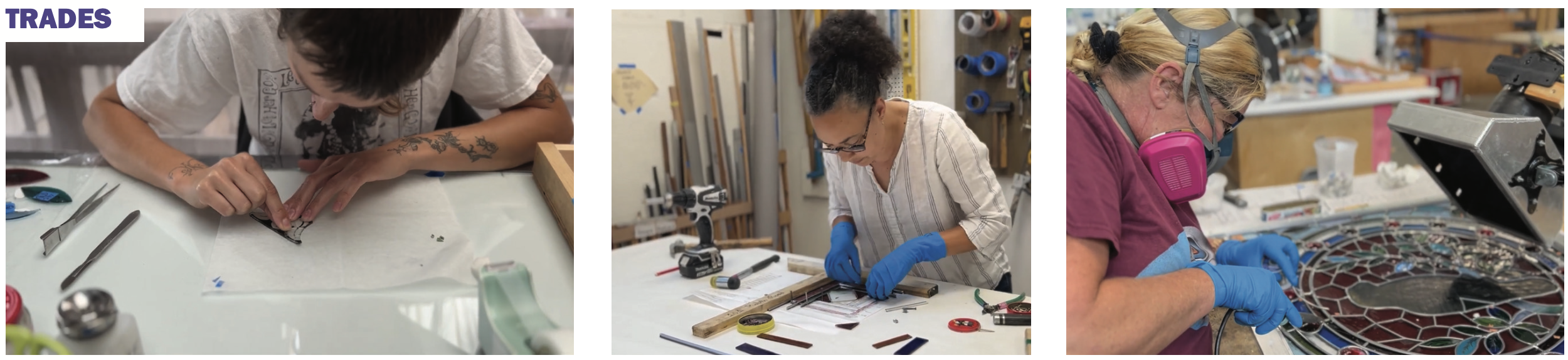
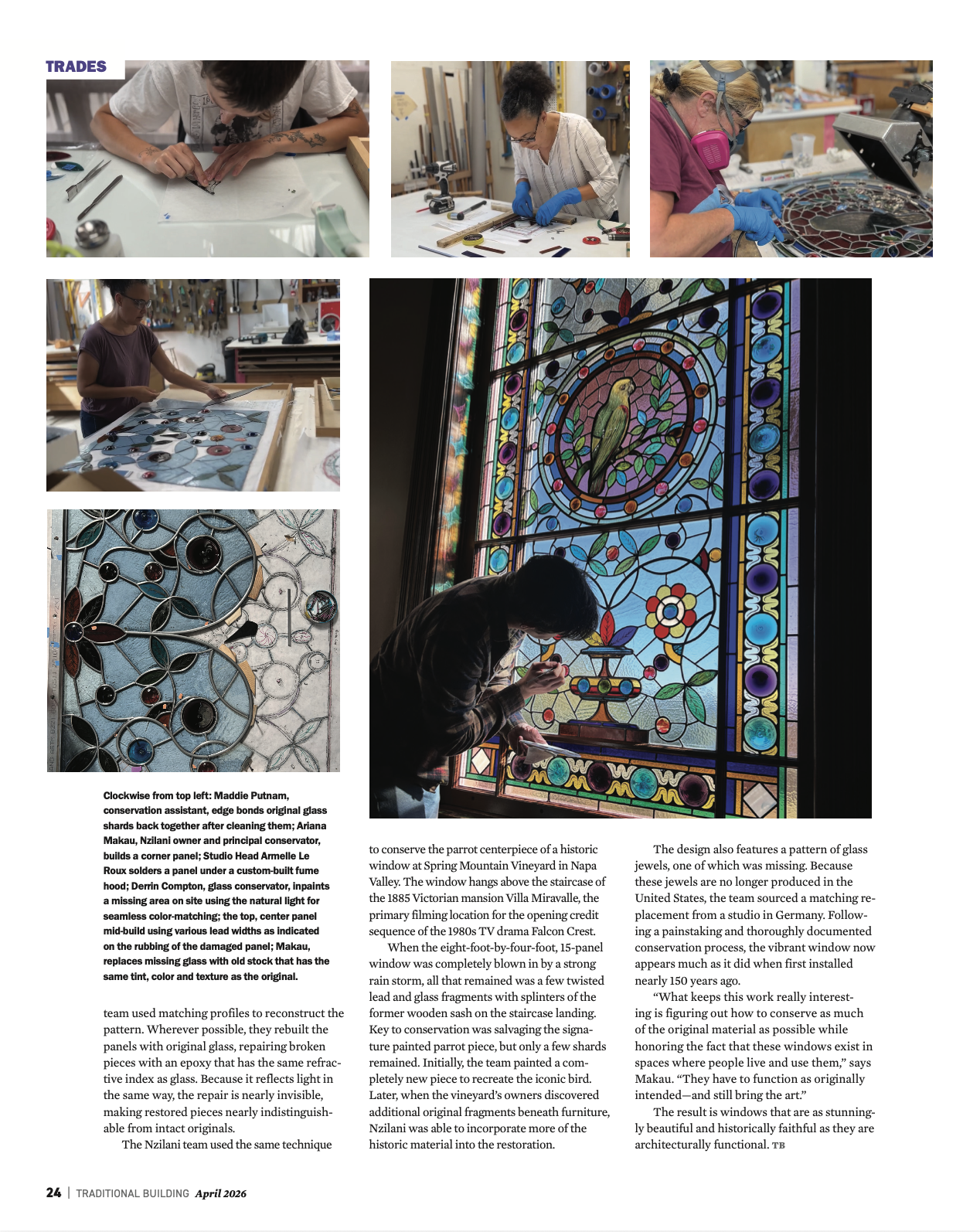
Clockwise from top left: Maddie Putnam, conservation assistant, edge bonds original glass shards back together after cleaning them; Ariana Makau, Nzilani owner and principal conservator, builds a corner panel; Studio Head Armelle Le Roux solders a panel under a custom-built fume hood; Derrin Compton, glass conservator, inpaints a missing area on site using the natural light for seamless color-matching; the top, center panel mid-build using various lead widths as indicated on the rubbing of the damaged panel; Makau, replaces missing glass with old stock that has the same tint, color and texture as the original.
After making rubbings of the lead cames to accurately document their construction, the team used matching profiles to reconstruct the pattern. Wherever possible, they rebuilt the panels with original glass, repairing broken pieces with an epoxy that has the same refractive index as glass. Because it reflects light in the same way, the repair is nearly invisible, making restored pieces nearly indistinguishable from intact originals.
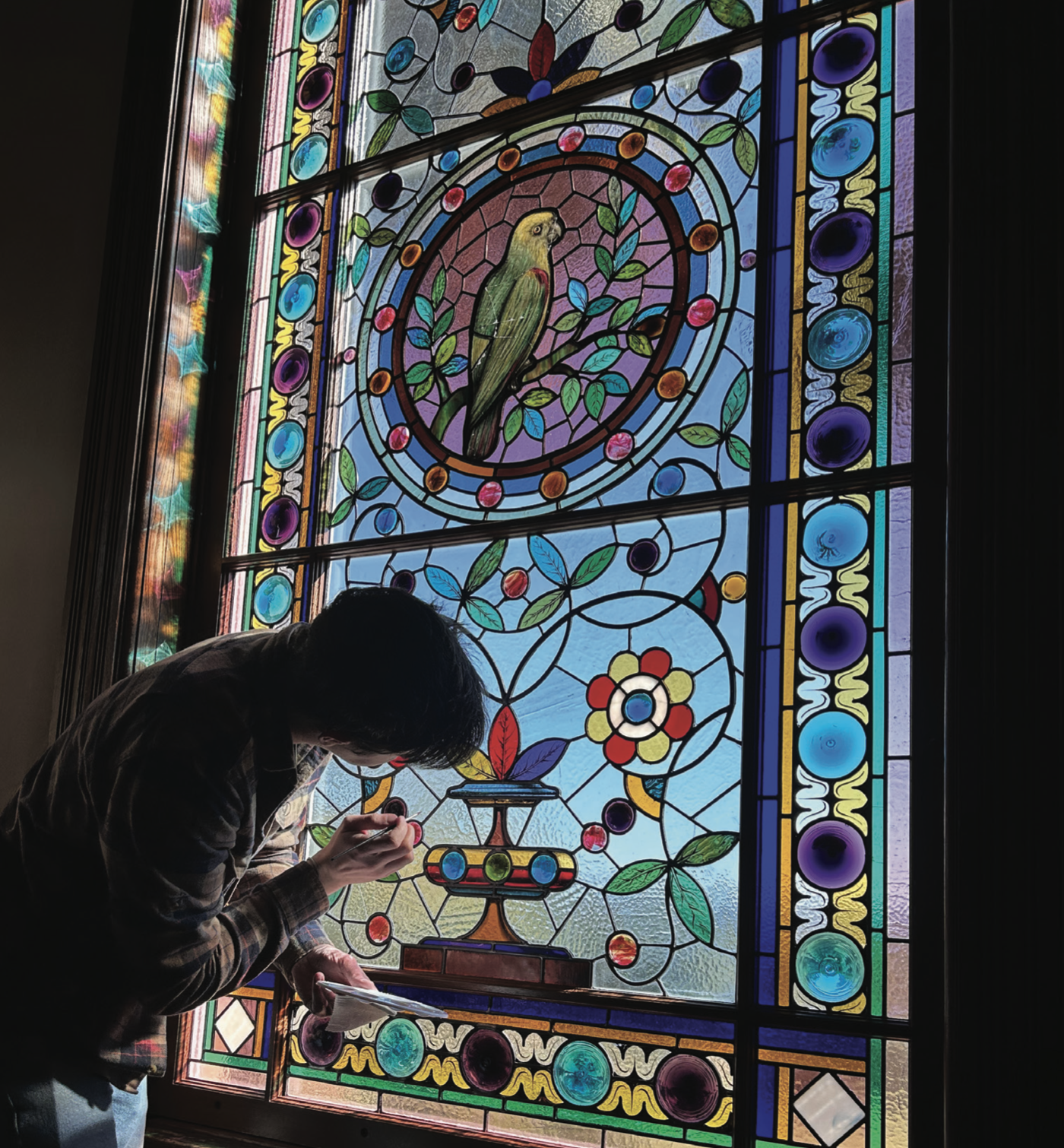
The Nzilani team used the same technique to conserve the parrot centerpiece of a historic window at Spring Mountain Vineyard in Napa Valley. The window hangs above the staircase of the 1885 Victorian mansion Villa Miravalle, the primary filming location for the opening credit sequence of the 1980s TV drama Falcon Crest.
When the eight-foot-by-four-foot, 15-panel window was completely blown in by a strong rain storm, all that remained was a few twisted lead and glass fragments with splinters of the former wooden sash on the staircase landing. Key to conservation was salvaging the signature painted parrot piece, but only a few shards remained. Initially, the team painted a completely new piece to recreate the iconic bird. Later, when the vineyard’s owners discovered additional original fragments beneath furniture, Nzilani was able to incorporate more of the historic material into the restoration.
The design also features a pattern of glass jewels, one of which was missing. Because these jewels are no longer produced in the United States, the team sourced a matching replacement from a studio in Germany. Following a painstaking and thoroughly documented conservation process, the vibrant window now appears much as it did when first installed nearly 150 years ago.
“What keeps this work really interesting is figuring out how to conserve as much of the original material as possible while honoring the fact that these windows exist in spaces where people live and use them,” says Makau. “They have to function as originally intended—and still bring the art.”
The result is windows that are as stunningly beautiful and historically faithful as they are architecturally functional.