Mitigating Lead Exposure in Stained Glass Conservation
March 1, 2019
By Ariana Makau, President & Principal Conservator of Nzilani Glass Conservation, Inc.
Ariana Makau of Nzilani Glass Conservation makes lead safety attainable and practical for studio implementation
The Stained Glass Quarterly (SGAA), Spring 2019
Read about the complications of working with a hazardous art material and what owners and workers need to do to protect themselves. This is a more formal complement to a presentation Ariana Makau delivered at the Smithsonian Safety & Cultural Heritage Summit to Health & Safety Regulators and Art Conservators.
When I founded Nzilani Glass Conservation over fifteen years ago, I felt overwhelmed by the myriad of Health and Safety (H&S) issues inherent to stained glass conservation in private practice. Having previously worked in an institutional setting, I was accustomed to having a protocol-based support system and personal protective equipment on hand in the conservation lab. But where could I begin as an independent conservator working on site and in the studio? Even knowing which safety measures to implement, how could they be presented to clients to (a) convey why Health and Safety (H&S) considerations were necessary, and (b) have them accept H&S as a billable line item? It was a challenging concept.
Part of growing Nzilani has involved forging that desire for safety into tangible practices and weaving it into our company culture. Our company’s three philosophical pillars are: “Be Safe. Have Fun. Do Excellent Work.” When we are safe, we are freer to enjoy our work, and the quality of our output reflects the synergy of these practices.
Be Safe—Know Your (True) Enemies
The independent conservator may feel that they are at cross-purposes with regulators and regulations. Previous articles in AIC Newsletters address these various agencies and how they can help you. In California, we work with the Division of Occupational Safety and Health (DOSH), better known as CAL/OSHA, or simply OSHA.
Stained glass conservators often have to remove and install windows in their architectural settings, meaning they also have to adhere to regulations set for the construction industry. The popular perception of these regulatory bodies is that they are punitive. On the contrary, they make the workplace safer and serve as a conservator’s resource center. Use them! That said, our experience has involved a steep learning curve from both sides.
The first step toward compliance is to find a specialist who is not only well versed in specific regulations in your field, but is also willing to partner with the conservator to improve the workspace within the parameters of conservation and code. The search for a good fit can be discouraging: When the conservator is motivated to be safe and in compliance, yet the regulator’s understanding of a studio’s workflow is impaired. It may take a few tries before the perfect ally is found within the regulatory landscape.
“Lead is Real!” is a playful platitude often repeated at Nzilani. Its naissance is derived from an early company lead safety class. Not adequately calibrated to our team’s level of awareness, it failed to address the specifics of our industry. The first uttered sentences in class were: “Lead is real; it is dangerous. You may not be aware that it can be found in many things you interact with every day.” The consultant had not researched that lead is one of the key materials we interact with daily, so this opening fell flat. Even years later, when attending a mandatory OSHA-approved Lead Worker Class, it was primarily structured for tradespeople exposed to lead paint, despite the instructor doing his best to customize the syllabus. We ultimately had to translate much of the literature and regulations ourselves.
The first step to mitigating a hazard is of course to identify it. The main hazard in stained glass conservation is 100% pure lead, a heavy metal with toxic properties. The conservation process involves numerous points of exposure: lead dust in oxidized lead came, newly extruded sheets, or came. Lead can also be found in conjunction with other hazardous materials, such as calcium carbonate (a.k.a. whiting), “red” lead and asbestos found in glazing putty, metal, or wooden frames, glass, or glass paint.
Testing
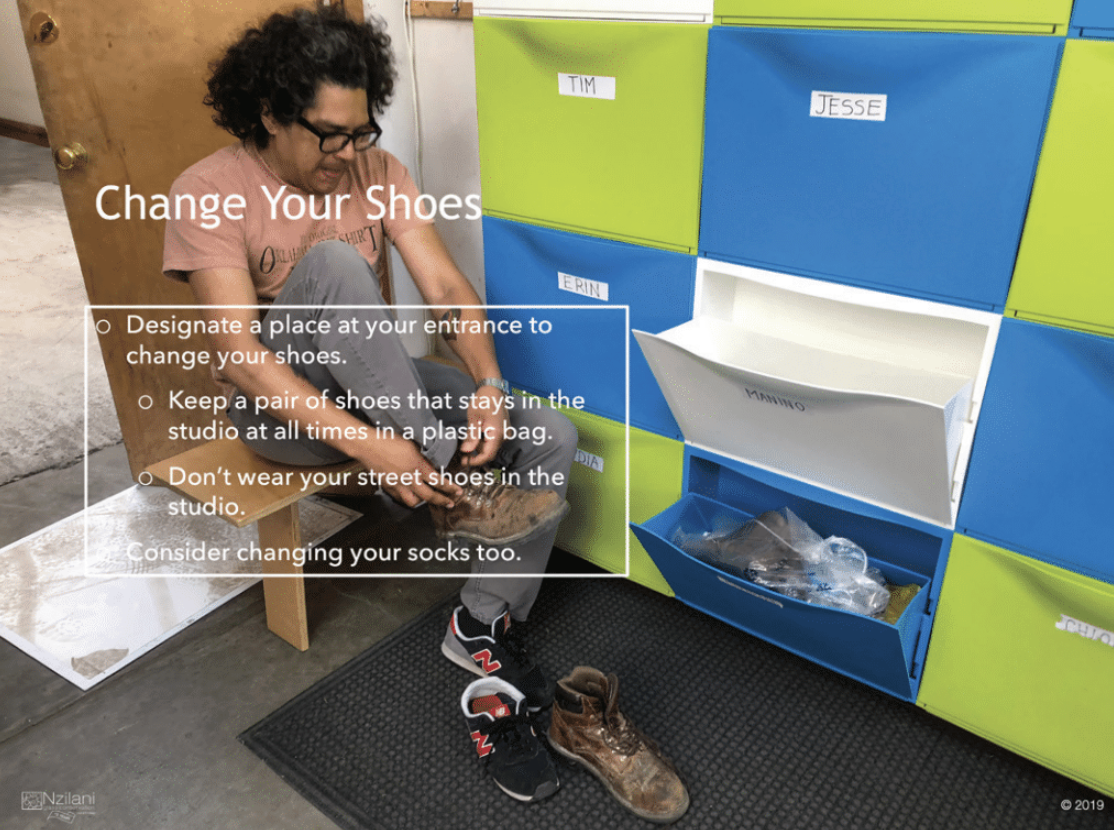
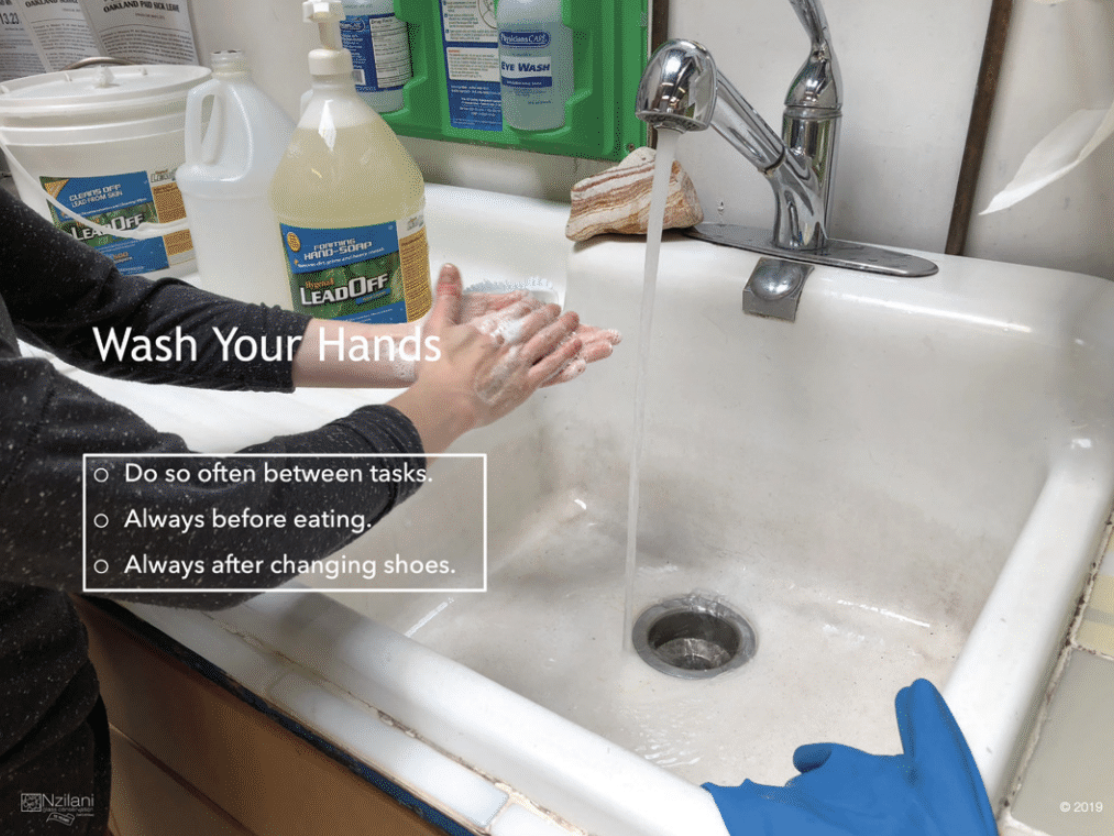
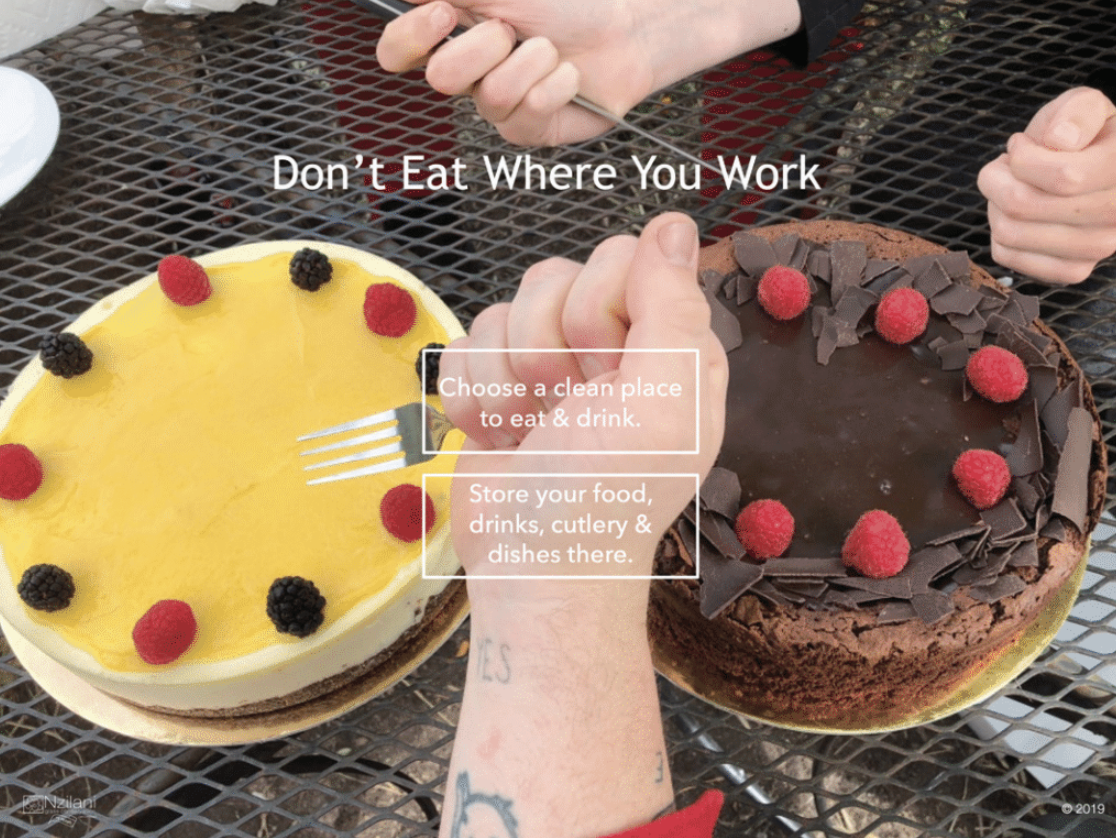
Air quality and surface testing for lead has given us quantifiable data for changing such long established studio practices such as glazing (building) windows with bare hands; using drinking cups in the work area; and wearing the same clothes at work and at home, elevating exposure risks to self and others. Testing has resulted in implementation of recommendations such as wearing disposable gloves, separating work and eating areas, changing clothes and footwear, and washing hands often.
Monitoring our blood lead levels provides another data set about the effectiveness of workplace practices and personal hygiene. As an independent conservator, I systematically test my blood lead levels and am able to see the correlation between safe practices, lead levels, and various treatment types. When Nzilani added employees, it was logical to track everyone’s levels biannually, beginning with a baseline test for each new employee before beginning work at the studio. Similarly, we give an “exit” test when an employee leaves Nzilani. This trackable data acts as markers of time worked at the company and provides us with feedback on the effectiveness of our H&S strategies. Although there is no “safe” level of lead, the CDC & OSHA Standards for blood lead levels are: 5.0mg/L or lower for the general population, and 40.0mg/L or lower for the lead-worker industry (e.g. construction or house painters).
Nzilani standards are more stringent; the average employee blood lead level was 3.6mg/L in our most recent company-wide test. Our stricter thresholds are in keeping with art conservation’s ethical standards with the assumption that art preservation should cause minimal risk to the practitioner. Our risk mitigation protocols and test results have proven that one can interact with lead safely on a daily basis in our industry.
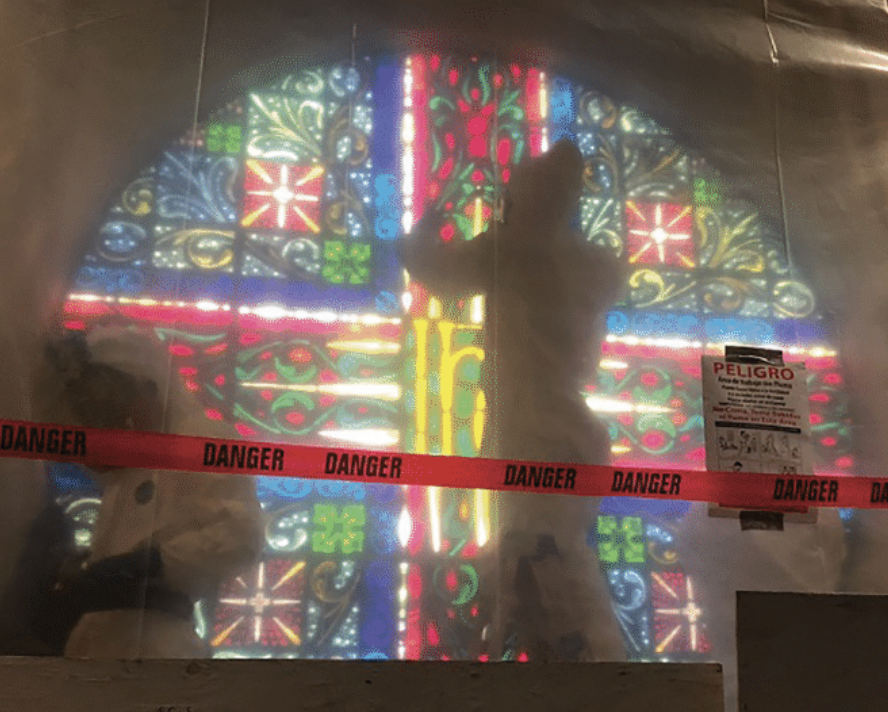
Containment for removal.
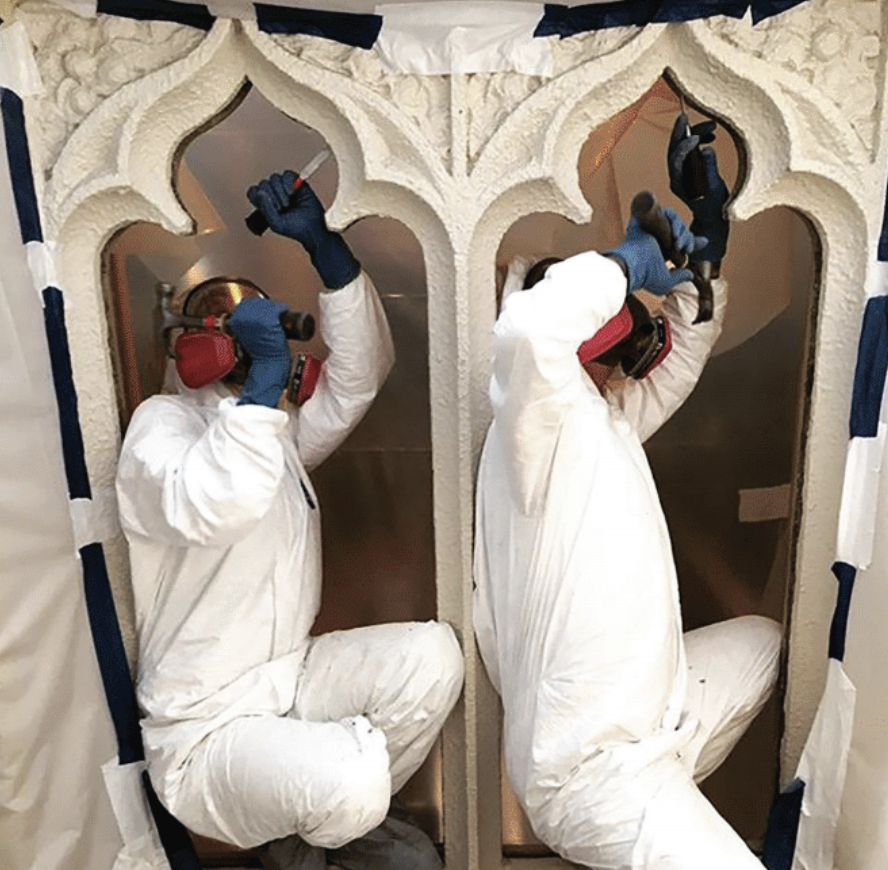
Site gear removal.
Personal Protective Equipment (PPE)
We have found that our understanding of lead exposure and containment is often on par or above that of the instructors of the certification classes for builders and contractors, and we have had to customize H&S practices to our needs. We experienced this anew during our goal to adhere to California’s strict lead disposal requirements.
To consult on customizing regulations to stained glass practice, Nzilani engaged a site hygienist who learned about our procedural treatment tasks before making any recommendations for improvement. Together, we identified our exposure limits in various tasks both on site and in the studio, after which we paired the proper PPE to each job, following the Permissible Exposure Limit (PEL) regulations as set out by OSHA.
OSHA specifies PPE by “trigger tasks.” In order to learn what our trigger tasks were, we took lead particulate samples from both the ambient air, as well as “inhaled air” by attaching a Gillian BDX-II Air Sampling Pump whose intake valve mimics a typical adult’s respiration rate. By acquiring a six- to eight-hour duration for each step of the treatment process, we could extrapolate a typical hourly exposure rate. Based on these results, and in consultation with the site hygienist, we created customized protocols and determined which PPE we should use in the studio and on site to be in compliance with OSHA guidelines.
Depending on task and location, we use a variety of PPE including aprons, coveralls, disposable “Tyvek” coveralls with hoods and booties, half- and full face respirators with rated cartridges, eye and ear protection, and disposable gloves. We also implement yearly respirator training and fit testing, which is scheduled closely with one of the biannual blood lead tests.
Have Fun—Necessity Breeds Invention
Drawing on the creative backgrounds of the Nzilani team, we are constantly conceiving risk-reducing improvements for the studio and on site. Since stained glass conservation is a hybrid between object conservation and construction, many of our in-house systems are custom made. The following are a few examples of how we have mitigated key trigger tasks. All tasks, except paperwork done in separate office settings, require the use of disposable gloves. Hands are washed often throughout the day, and when transitioning from work to breaks.
Soak Tank
In the studio, H&S measures are implemented as soon as a leaded glass panel arrives, as historical panels usually have some amount of oxidized lead. This type of exposure requires at least a half-mask respirator with P100 filters, while both sides of the panel are HEPA-vacuumed. After a rubbing is taken of the original window design, the panel is placed in the soak tank to loosen the old putty for dismantling. Unless the glass paint is unstable, all the dismantling happens under water, reducing our exposure and ensuring the old lead is contained in all its forms. Our soak tanks were designed by team members to our specifications and fabricated locally in collaboration with a vendor who specializes in water filtration. Effluent water is strained through multiple filters down to 1 micron in order to enter city drainage systems safely.
Lead Recycling & Sludge Disposal
The old lead generated during dismantling gets placed in SDS-labeled containers to be taken for recycling. We keep these buckets closed, and periodically moisten the contents to prevent lead dust escaping when additional old lead is added. We also recycle any unusable pieces of new lead came, which are collected in their own separate containers to reduce the spread of lead dust. Both go to a qualified lead intake facility. The dismantling process also results in containers full of old glazing putty, a sludge-like waste material containing lead, requiring proper disposal. One of the challenges of being a niche industry is that we have had difficulty conveying to various local municipality representatives the specifics of our work so that they could recommend which hazardous waste protocols we should follow.
Glass Paint
Often, glass paint is a medium that is overlooked as hazardous, as people perhaps assume that it is like acrylic or tempera paints. However, as a vitreous paint, this medium is a combination of ground glass and pigment oxides, often with a lead flux. This paint requires prudent handling, and we use P100 filters in our half-face respirators while glass painting.
Soldering & Articulated Fume Hoods
Nzilani created a bespoke system of mounted vent hoods which feed to an industrial air scrubber for use during soldering, a trigger task. After various prototypes, we settled on a final workbench hood system designed by a crew member and fabricated by a local metal worker. The mobile anchoring system integrates existing laptop arm technology with customized aluminum vent-hood holsters to provide close and steady placement to the work. Team members also use half-mask respirators with a dual vapor and P100 cartridge filter during soldering.
Particulates Created During Treatment
In addition to lead dust, the team encounters other particulates during the treatment of panels. During the puttying phase, both sawdust and calcium carbonate (whiting) are used. Puttying is restricted to a small room with a dedicated air scrubber. The small cubic square footage ensures the air is scrubbed at a fast rate, and during high volume work, the filters are checked once every two weeks. P100 filters for respirators also effectively protect against sawdust and whiting.
Do Excellent Work
Nzilani employees come from a wide range of cultural and experiential backgrounds. Some are artists, while others have transferable skills from other professions; very few have a conservation background, yet all are integral to Nzilani’s success. We support a culture of self-regulation, beginning with simple daily actions such as changing between street and work shoes at the beginning and end of each work day, and frequent hand washing. More detailed safety procedures are conveyed via posted treatment protocol sheets, periodic lead awareness classes, weekly meetings that follow our three-pillar structure, and quarterly Health and Safety meetings. The entire team participates in a weekly deep-cleaning of the studio in addition to daily cleaning of individual stations. Learning to combine the realities of everyday stained glass treatment with regulatory expectations is an ongoing process. Our company’s procedures have been cultivated over time, and we often update them with new ideas and improvements to old systems. Taking the lead in mitigating hazards within our workplace not only benefits us, but it also informs others in similar industries. All our protocols are applicable even where stained glass is practiced as a hobby on a smaller scale. Finally, if regulatory bodies interact with conservators and conservation more frequently, then we can continue to inform each other successfully. This will result in clearer and more accessible practical recommendations—and a safer environment for everyone.
Ariana Makau has been involved in the field of conservation for over 20 years, having worked at the J. Paul Getty Museum, the Victoria & Albert Museum and the Metropolitan Museum of Art. She is a Professional Associate of the American Institute for Conservation of Historic and Artistic Works (AIC), a member of the Women Presidents Organization (WPO) and acts as an Independent Stained Glass Conservator/Consultant with various art institutions that do not have stained glass conservators on staff. A native Californian, Ariana returned to the Bay Area after receiving her Masters in Stained Glass Conservation at the Victoria & Albert Museum/ Royal College of Art, in London, England. She founded and has been the president and principal conservator of Nzilani Glass Conservation, Inc. since 2003. The company specializes in glass conservation, restoration, survey condition reports, and commissioned works. Nzilani’s mission of “Be Safe. Have Fun. Do Excellent Work.” also describes Ariana. Personal safety has always been a driving force in all of her work; as she believes that if you are aware of your environment and materials, it frees you up to do your best and have fun doing it.
Read the original publication here.